
Blog
How long does an average automatic car wash take at popular service providers?

When a customer asks, “How long does an automatic car wash take?”, they are calculating the value of their time against the price of the service. For a car wash investor or operator, this question must be reframed into a far more critical business metric: “What is my optimal throughput, and how can my equipment and processes maximize my Vehicles Per Hour (VPH)?” The time a customer spends at your facility, from the moment they enter the driveway to the moment they leave, is a direct reflection of your operational efficiency and a primary driver of your revenue potential and profitability.
This B2B analysis will deconstruct the concept of “wash time” from an operator’s perspective. We will dissect the key variables that determine the total duration of a customer’s visit, from queue management and payment processing to in-tunnel conveyor speed and drying efficiency. Understanding how to control these variables is the key to designing a car wash that not only satisfies the customer’s need for speed but also functions as a high-volume, financially optimized processing plant. At AUTOSHER, we engineer our systems not just to wash cars, but to do so within a precisely controlled time frame that maximizes an operator’s return on investment.
Section 1: Translating Time into Throughput (VPH)
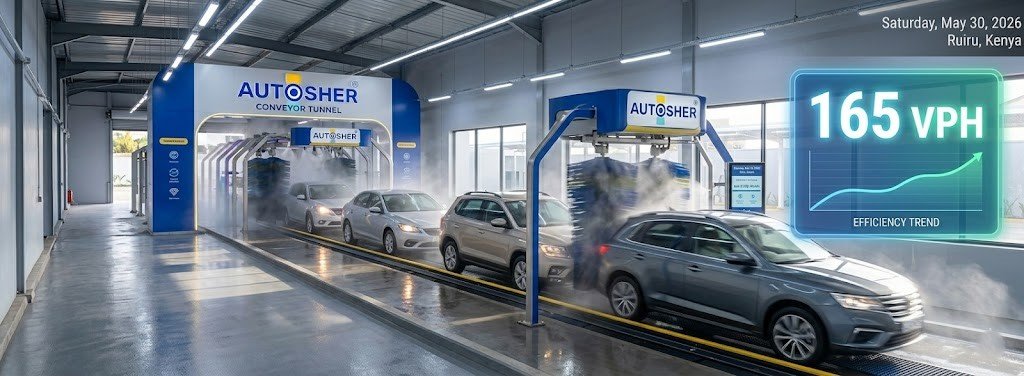
In the express exterior car wash model, the single most important Key Performance Indicator (KPI) is Vehicles Per Hour (VPH). This metric dictates your revenue ceiling, especially during peak periods like a sunny Saturday afternoon. The “time” of the wash is simply one component of the VPH calculation.
The Fundamental Equation of Revenue
Consider two hypothetical tunnels. Tunnel A takes 5 minutes to process a car from entry to exit. Tunnel B, through superior design and efficiency, takes only 3 minutes.
- Tunnel A (5 min/car): 60 minutes / 5 minutes = 12 VPH.
- Tunnel B (3 min/car): 60 minutes / 3 minutes = 20 VPH.
At an average ticket of $15, the difference is stark:
- Tunnel A Revenue Potential: 12 VPH * $15 = $180 per hour.
- Tunnel B Revenue Potential: 20 VPH * $15 = $300 per hour.
Over a 10-hour peak day, that’s a difference of $1,200 in potential revenue. The operator of Tunnel B understands that shaving minutes and seconds from the process is not just about customer convenience; it’s a direct investment in profitability. The entire system must be engineered to safely and effectively minimize the time per vehicle.
Defining “Total Time”
From the customer’s perspective, the “wash time” includes three phases:
- Queue and Payment Time: The time spent waiting in line and interacting with the payment kiosk.
- In-Tunnel Time: The actual time the vehicle spends on the conveyor moving through the wash and dry process.
- Exit and Finishing Time: The time spent exiting the tunnel and, if applicable, using vacuum bays.
A top-tier operator must analyze and optimize all three phases. A 3-minute tunnel is of little value if customers routinely wait 10 minutes just to pay.
Section 2: The Conveyor – The Pacemaker of Your Operation
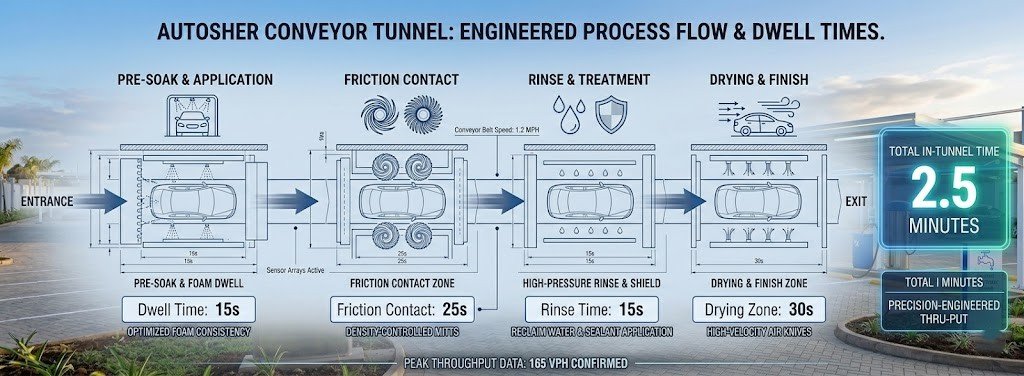
The conveyor is the heart of your car wash’s efficiency. Its speed, length, and design directly dictate your maximum possible VPH. The goal is to move the conveyor as fast as possible while still allowing each piece of equipment enough time to do its job effectively.
Conveyor Speed and Tunnel Length
These two variables are inextricably linked. A longer tunnel allows for a faster conveyor speed because the vehicle spends more time in front of each piece of equipment. For example, to allow a friction brush 10 seconds of contact time, a 100-foot tunnel might have to run at a slower speed than a 140-foot tunnel. The design process involves a careful balancing act, selecting the right equipment and tunnel length to achieve a target VPH. AUTOSHER’s design consultants work with investors to model these variables, ensuring the final layout is optimized for their specific business goals.
The Importance of Vehicle Spacing (Stacking)
Even with a fast conveyor, VPH will suffer if there are large gaps between vehicles. The goal is to have the front bumper of the next car as close as safely possible to the rear bumper of the car in front. This is known as “stacking.” Efficient stacking relies on:
- A Modern Conveyor System: Flat belt conveyors, like AUTOSHER’s GuideTrack system, are often perceived as easier and faster for customers to load onto compared to older chain-and-roller systems, reducing hesitation and loading time.
- Clear Instructions: Bright, simple LED signs and audio prompts that clearly guide the driver onto the conveyor are essential.
- Well-Trained Attendants: During peak hours, having an attendant guide cars onto the conveyor is the fastest way to ensure tight, consistent spacing.
Section 3: Optimizing the In-Tunnel Process
Every piece of equipment in the tunnel must perform its function within a limited time window defined by the conveyor speed. This requires high-performance, efficient components.
Application and Dwell Time
Chemicals like pre-soaks need a certain amount of “dwell time” to break down road film. High-efficiency application arches that apply chemicals quickly and evenly are crucial. If your pre-soak takes too long to apply, you must slow the entire line down.
Friction and Rinsing
The friction wash equipment must be able to clean effectively with a limited number of passes over the vehicle. This is where the design of the brushes and the intelligence of the control system come into play. A system that contours to the vehicle shape cleans more effectively in less time. High-pressure rinsing arches must have the power and coverage to completely remove all soap residue as the car passes by at speed.
The Drying Challenge
Drying is often the biggest bottleneck in a high-speed tunnel. A car that exits wet will lead to customer complaints. Simply adding more horsepower is not the answer. An efficient drying system, like AUTOSHER’s WindShear dryers, uses intelligently designed nozzles that contour to the vehicle’s shape and focus a high volume of air where it’s needed most. This allows for a completely dry vehicle at conveyor speeds that would leave cars emerging from older systems soaking wet.
Section 4: The Bottleneck at the Gate – Queue and Payment Optimization
As mentioned, a fast tunnel is irrelevant if the entrance is slow. Minimizing the time from arrival to conveyor loading is a critical component of maximizing VPH.
Modern POS Systems
A modern Point of Sale (POS) system is essential. Key features that reduce transaction time include:
- Multiple Kiosks: Prevents a single indecisive customer from holding up the entire line.
- Intuitive Touchscreens: A simple, graphical menu that is easy to understand reduces decision time.
- Fast Payment Processing: Acceptance of NFC tap-to-pay (cards and mobile wallets) is the fastest transaction method and a customer expectation.
The Membership Express Lane
This is the ultimate tool for maximizing throughput. By using License Plate Recognition (LPR) or RFID technology, members can bypass the payment kiosk entirely. An LPR camera identifies their vehicle, verifies their membership, and opens the gate automatically. This process takes seconds and allows you to create a dedicated “Members Only” lane that flows incredibly quickly, delighting your most valuable customers and dramatically increasing your site’s overall capacity.
Section 5: The Role of Uptime and Reliability
The final factor in “how long a wash takes” is whether the wash is running at all. Unplanned downtime is the ultimate VPH killer. A single hour of downtime on a peak day can cost hundreds of dollars in lost revenue and damage your brand’s reputation for reliability.
Investing in Durability
Choosing equipment built with robust materials like stainless steel and oversized components is a long-term investment in uptime. A lower upfront cost for inferior equipment will inevitably lead to higher lifetime costs through more frequent repairs and lost operating hours.
Remote Diagnostics and Preventative Maintenance
Modern car wash systems, like those from AUTOSHER, are equipped with remote monitoring capabilities. Our technicians can often diagnose a developing issue—like a motor drawing too much current or a sensor beginning to fail—before it causes a complete shutdown. This allows for proactive, scheduled maintenance during off-peak hours instead of reactive, emergency repairs during the Saturday rush. This focus on maximizing uptime is the final, crucial piece in ensuring your car wash is always ready to process customers as quickly and efficiently as possible.

Conclusion: Time is Money, Efficiency is a Strategy
The time an average automatic car wash takes is not a fixed number; it is a direct result of a thousand strategic decisions made by the operator. By investing in an integrated system with a high-speed conveyor, efficient in-tunnel components, a frictionless payment process, and a commitment to reliability, an operator can significantly reduce the total time per customer. This reduction translates directly into higher throughput, greater revenue potential, superior customer satisfaction, and a dominant position in the marketplace.