
Blog
How do I find an automatic car wash that offers eco-friendly cleaning options?

When a consumer searches for an “eco-friendly car wash,” they are signaling a shift in market consciousness. They are looking for a business that aligns with their values of sustainability and environmental responsibility. For a car wash investor or operator, this search query represents one of the most significant modern opportunities: the chance to transform operational necessities into a powerful, profitable marketing advantage. “Eco-friendly” is no longer a niche preference; it is a mainstream demand that can drive customer loyalty and justify premium pricing.
This B2B analysis will deconstruct what it truly means to be an eco-friendly car wash from an operational and financial standpoint. We will explore the core technologies of water reclamation, energy efficiency, and sustainable chemistry that form the foundation of a genuinely “green” operation. More importantly, we will demonstrate how these investments are not expenses, but rather strategic decisions that drastically reduce operating costs, ensure regulatory compliance, and create a compelling brand story that resonates with today’s environmentally aware consumer. AUTOSHER systems are engineered at their core for efficiency, providing operators with the tools to build a business that is both environmentally and fiscally sustainable.
Section 1: The Heart of Green Operations – Advanced Water Reclamation
The single largest environmental impact of a car wash is its water consumption. Therefore, the most significant feature of any eco-friendly car wash is a high-efficiency water reclamation system. This technology is the cornerstone of any credible environmental claim.
The Problem with Unmanaged Water Use
A traditional car wash without a reclamation system can use over 100 gallons of fresh water per vehicle. In an era of increasing water scarcity, droughts, and rising utility costs, this level of consumption is both environmentally irresponsible and financially unsustainable. Furthermore, the untreated effluent from such a wash carries detergents, oils, and heavy metals into the sewer system, placing a greater burden on municipal treatment facilities.
The Reclamation Solution
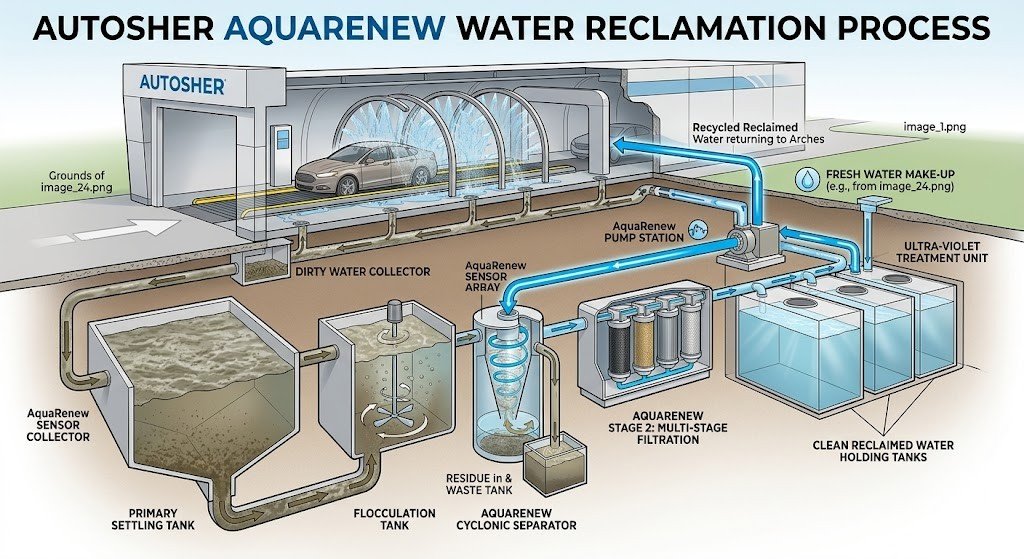
A modern water reclamation system, like AUTOSHER’s AquaRenew, is a sophisticated water treatment plant in miniature. The process typically involves multiple stages:
- Settling Tanks: Large underground tanks allow heavy solids and sludge to settle out of the used wash water.
- Cyclonic Separation: Water is pumped into a centrifugal separator that spins the water at high velocity, forcing finer particulate matter out through centripetal force. This is highly effective at removing the abrasive grit that could damage a vehicle’s finish.
- Filtration and Treatment: The water may then pass through various filtration media and often undergoes an ozone or aeration treatment to eliminate bacteria and control odors.
The result is clean, reusable water that can be used for the initial rinsing and friction stages of the wash. By reclaiming and reusing up to 90% of its water, a modern car wash can reduce its fresh water consumption to as little as 10-15 gallons per vehicle. This is a staggering improvement and a verifiable fact that forms the basis of a powerful marketing message.
The Financial ROI of Water Conservation
The investment in a reclamation system pays for itself. By slashing water and sewer bills—two of the largest variable costs in a car wash—the system generates a clear and often rapid return on investment. It also insulates the business from the financial impact of drought-related water rate hikes and restrictions, a critical risk-management benefit.
Section 2: Energy Efficiency – Reducing the Carbon Footprint and Operating Costs
After water, electricity is the next major operational cost and environmental consideration. An eco-friendly car wash is engineered to minimize its energy consumption at every stage. The largest energy consumers are the powerful electric motors that drive the conveyor, brushes, and, most significantly, the air dryers.
Variable Frequency Drives (VFDs)
A VFD is a type of motor controller that adjusts the motor’s speed and torque by varying the frequency and voltage of the electrical power supplied to it. In a car wash context, this technology is a game-changer:
- Soft Starts: Instead of slamming on at full power, VFDs allow motors to ramp up smoothly, reducing mechanical shock and wear on components like gearboxes and bearings.
- Energy Modulation: A VFD allows a dryer motor to run at, for example, 80% power for a small car and ramp up to 100% for a large van, using only the energy that is actually needed. This is far more efficient than running at full power for every vehicle.
- Smart Control: When integrated with the tunnel’s PLC, VFDs ensure that motors are only running at full speed when a vehicle is in the optimal position, and can idle down or shut off completely between cars.
Intelligent Dryer Design
Modern dryers, like AUTOSHER’s WindShear system, are designed for efficiency, not just brute force. They use computer-modeled nozzle designs that create a more effective “air knife,” shearing water off the vehicle with velocity and volume rather than just raw horsepower. This allows them to dry cars more effectively while using less energy than older, less sophisticated designs.
Section 3: The Chemistry of Sustainability
The “eco-friendly” label also applies to the chemicals used in the wash process. A responsible operator chooses detergents and waxes that are both effective and environmentally benign.
Biodegradability and Phosphate-Free Formulas
Professional car wash detergents should be readily biodegradable, meaning they can be broken down quickly by natural processes. They should also be phosphate-free. Phosphates, once common in cleaning agents, can cause algal blooms in waterways, depleting oxygen and harming aquatic life. Using certified “green” or “eco” chemical lines is a key component of a sustainable operation.
The Efficiency of Concentrates
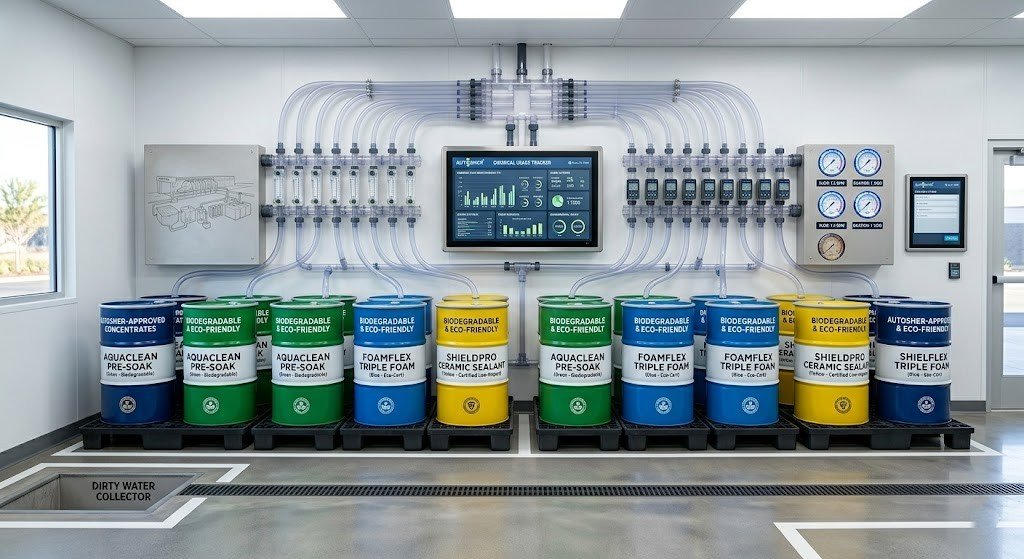
Professional car wash chemicals are typically sold as ultra-concentrates. An automated dilution system, like a hydrominder, mixes a precise amount of chemical with water at the point of application. This is environmentally friendly for several reasons:
- Reduced Shipping Footprint: Shipping a 30-gallon drum of concentrate is far more efficient than shipping hundreds of gallons of ready-to-use product.
- Less Plastic Waste: One large drum replaces hundreds of smaller plastic bottles.
- Prevents Waste: The precise dilution system ensures that no chemical is wasted, which is good for both the environment and the operator’s bottom line.
Section 4: Marketing Your Green Credentials
Investing in eco-friendly technology and practices is only half the battle. The other half is communicating these benefits effectively to your customers. This is how you turn your operational efficiencies into a revenue-generating marketing strategy.
On-Site Education and Signage
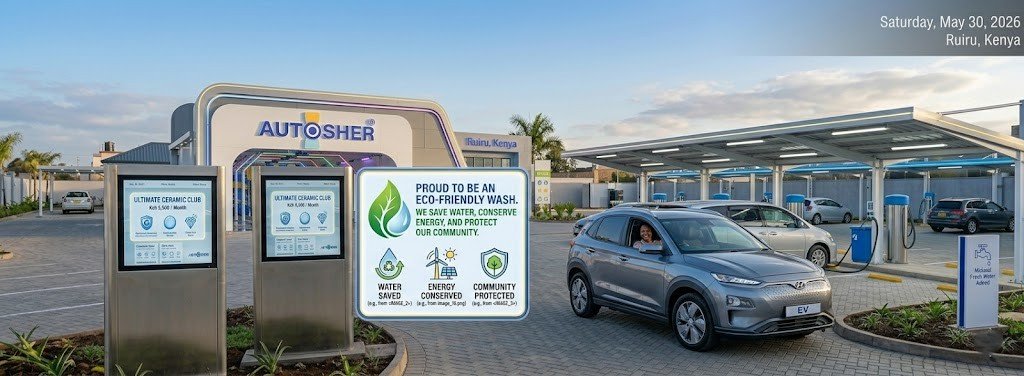
Your facility is your primary marketing tool. Use prominent, professional signage to tell your story:
- At the payment kiosk: “We Recycle 90% of Our Water to Protect Our Local Rivers!”
- In the tunnel: “Our energy-efficient motors reduce our carbon footprint with every wash.”
- At the vacuum bays: “Our biodegradable soaps are safe for your car and the environment.”
This on-site messaging educates customers and reinforces their decision to choose your business. It makes them feel good about their purchase.
Digital Storytelling
Use your website, blog, and social media channels to go deeper. Create a dedicated “Sustainability” page on your website that explains your water reclamation system. Post videos showing the technology in action. Share infographics that compare the water usage of your professional wash to a typical driveway wash. This content positions you as a transparent and responsible community leader.
Section 5: The Complete Picture – A Sustainable Business Model
Ultimately, an eco-friendly car wash is a holistically sustainable business. The various components work together to create a virtuous cycle.
Cost Savings Drive Competitiveness
The money saved on water, sewer, and electricity can be reinvested into the business—in better marketing, higher employee wages, or improved facilities. These lower variable costs also provide a competitive advantage, allowing for greater pricing flexibility and higher profit margins.
Attracting a Premium Clientele
Customers who are actively seeking out eco-friendly businesses are often less price-sensitive and more loyal to brands that share their values. By marketing your green credentials, you attract a desirable customer demographic that is more likely to purchase top-tier wash packages and sign up for monthly memberships.
Future-Proofing Your Investment
As environmental regulations become stricter and resource costs continue to rise, businesses that have already invested in efficient, sustainable technology will be years ahead of their competitors. An eco-friendly design is not just for today; it is a strategic decision that ensures the long-term viability and profitability of your investment.
Conclusion: Good for the Planet, Great for the Bottom Line
Finding an eco-friendly automatic car wash is becoming easier because smart operators recognize it is simply a better way to do business. The technologies that reduce environmental impact—water reclamation, energy-efficient motors, and concentrated chemicals—also happen to be the same technologies that reduce operating costs and increase profitability. By embracing sustainability, a car wash operator can build a brand that appeals to modern consumer values, insulates their business from future resource volatility, and creates a powerful, lasting competitive advantage.