
Blog
Is it better to use an automatic car wash or wash by hand?

The ability to clearly, confidently, and factually articulate the superiority of your professional service over the amateur hand wash is fundamental to your marketing, customer education, and overall brand positioning. You are not just selling convenience; you are selling a demonstrably better and safer result.
This B2B analysis will arm you, the operator, with the scientific, environmental, and economic arguments needed to win this debate. We will conduct a head-to-head comparison, moving beyond anecdotal evidence to examine the microscopic impact on paint, the verifiable data on environmental responsibility, and the business model implications of each method. The goal is to provide a definitive resource that empowers you to dismantle common myths and establish your facility as the clear choice for vehicle preservation and care. The advanced technology in an AUTOSHER system is what provides the proof behind these claims.
Section 1: The Paint Safety Verdict – A Microscopic Analysis
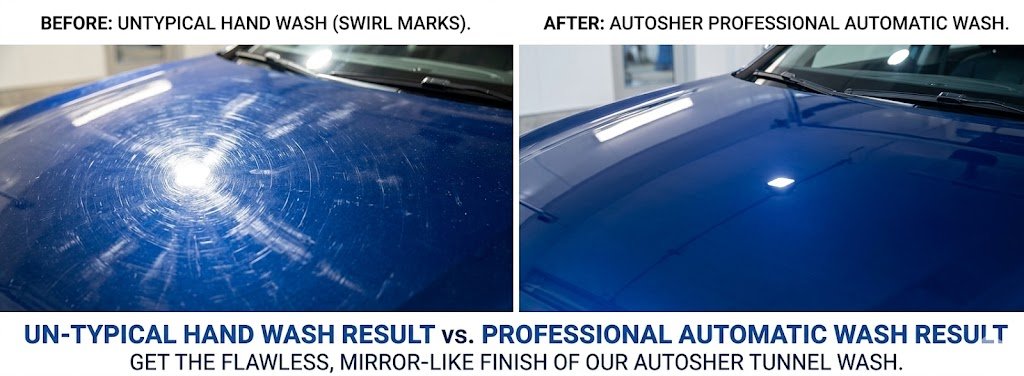
The primary argument for hand washing is that it is gentler. This is the single biggest myth in automotive care. A typical “bucket and sponge” wash is one of the most damaging procedures you can perform on your car’s paint.
The Hand Wash: A Recipe for Scratches
The process is inherently flawed. A wash mitt or sponge is rubbed across a dirty vehicle panel, picking up sharp particles of sand and grit. This contaminated mitt is then dunked back into a single bucket of soapy water, polluting the entire solution. The same grit-filled mitt is then dragged across the rest of the car’s bodywork. On a microscopic level, this is akin to washing your car with fine-grit sandpaper. This process is the primary cause of the fine, web-like scratches known as “swirl marks” that are especially visible on dark-colored paints. While professional detailers use a meticulous two-bucket method and grit guards, this is not the reality of the average driveway wash.
The Modern Automatic Wash: A System of Safety
A professional automatic wash is engineered to eliminate this very problem.
- Pre-Wash Stage: The process begins with a high-pressure rinse to remove the large, loose abrasive particles before any physical contact is made.
- Constant Lubrication & Flushing: During the friction stage, the vehicle and the wash media are continuously flooded with high-lubricity, pH-balanced soap. This creates a protective barrier and ensures that any dirt is immediately flushed away.
- Non-Porous Media: AUTOSHER’s closed-cell foam brushes do not absorb dirt. They are non-porous, so grit cannot become trapped. They clean by gently skimming the lubricated surface, providing a level of safety that is impossible to replicate with a sponge.
Verdict: From a material science perspective, a modern automatic car wash is scientifically safer for a vehicle’s clear coat than a typical hand wash.
Section 2: The Environmental Impact – A Clear Conscience
This is where the debate ends for many regulators and environmentally conscious consumers. A professional car wash is vastly more eco-friendly than washing a car in the driveway.
The Hand Wash: Uncontrolled Pollution
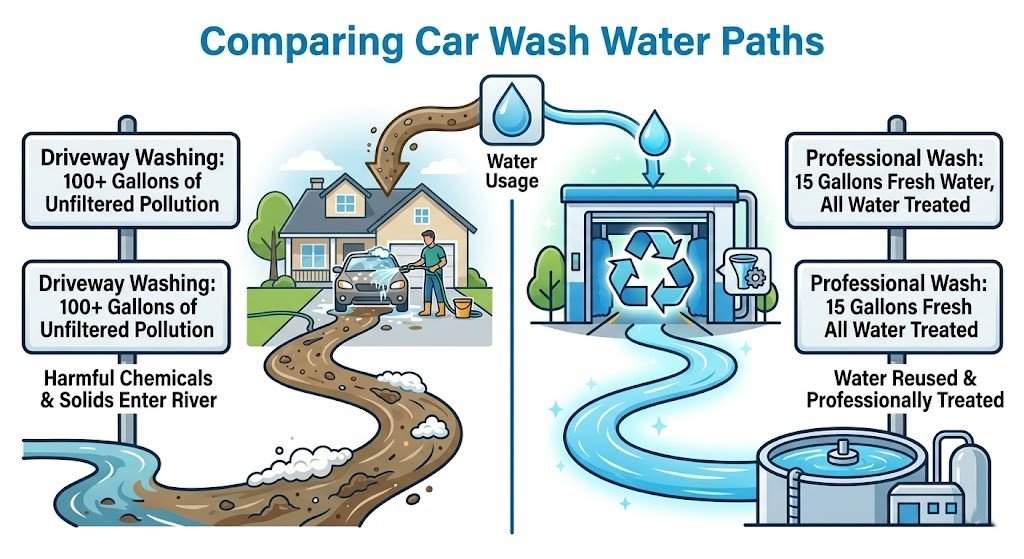
A typical driveway wash uses between 80 and 140 gallons of fresh water. More critically, that water, now contaminated with soap, brake dust, oil, and heavy metals, flows directly into the storm drain system. Storm drains lead directly to local rivers, lakes, and oceans without any treatment. This uncontrolled runoff is a significant source of water pollution and is illegal in many municipalities.
The Automatic Wash: A Closed-Loop System
A professional car wash is a model of environmental responsibility.
- Water Conservation: With a water reclamation system, a professional wash can reduce its fresh water consumption to as little as 10-15 gallons per car—a reduction of nearly 90%.
- Proper Waste Disposal: All water discharged from a professional car wash is sent to a sanitary sewer, where it is properly treated at a municipal facility before being returned to the environment.
- Biodegradable Chemicals: Reputable operators use professional-grade, biodegradable, and phosphate-free detergents that are formulated for environmental safety.
Verdict: The professional automatic car wash is the overwhelmingly superior choice for environmental protection and water conservation.
Section 3: Consistency and Thoroughness – The Machine vs. Human Error
A car wash is a process. A professional operation relies on the precision of machinery to deliver a consistent, high-quality product every time.
The Hand Wash: Inconsistency is Guaranteed
A hand wash is subject to human factors. The person may be tired, miss a spot, use too much or too little soap, or fail to rinse an area properly. It’s nearly impossible to ensure every square inch of the car, including the roof and lower panels, receives the same level of attention.
The Automatic Wash: Precision and Repetition
An automated system does the same thing perfectly every time.
- Precise Chemical Dilution: Automated systems mix the exact required amount of chemical concentrate, ensuring optimal performance and safety. A hand wash is guesswork.
- Comprehensive Coverage: Automated brushes and high-pressure arches are designed to reach every part of the vehicle’s exterior, from the rocker panels to the center of the roof.
- Undercarriage Cleaning: This is a critical maintenance task that is nearly impossible to do by hand. An automatic wash can offer a high-pressure undercarriage flush that removes corrosive salt and grime, extending the life of the vehicle.
Verdict: For a consistent, thorough, and repeatable result, the precision of an automated system is unbeatable.
Section 4: The Economic Reality – The Value of Time and Throughput
For the customer, the choice often comes down to the value of their time. For the operator, this translates directly into the viability of the business model.
The Hand Wash: A Time-Consuming Chore
A proper hand wash, including setup, washing, rinsing, drying, and cleanup, can easily take 60-90 minutes of a person’s time. For most people, that time has a significant value.
The Automatic Wash: The Express Model
A modern express exterior car wash can deliver a clean, dry car in under 3 minutes. This incredible speed is the foundation of the business model. While a hand wash bay can service one car per hour, a 120-foot express tunnel can process over 150 cars per hour. This massive difference in throughput is what makes the professional car wash a scalable, highly profitable enterprise.
Verdict: The automatic car wash offers an exponential advantage in time savings for the customer and revenue potential for the operator.

Section 5: Conclusion for the Operator – A Clear and Defensible Position
As a car wash operator, you are not just in the business of cleaning cars; you are in the business of solving problems for your customers. You solve the problem of a dirty car in a way that is faster, safer for the paint, and better for the environment than the alternative. Arming yourself with these facts allows you to:
- Educate Your Customers: Use signage and website content to explain the benefits of your closed-cell foam and water reclamation systems.
- Train Your Staff: Ensure your employees can confidently answer customer questions about paint safety.
- Market with Authority: Build marketing campaigns around your key differentiators: “Scientifically Safer Than Hand Washing,” or “Save 100 Gallons of Water With Every Wash.”
The debate is over. A modern, professional automatic car wash is unequivocally better than a typical hand wash on every key metric: safety, environmental impact, consistency, and efficiency.