Blog
Are there automatic car washes that include undercarriage cleaning?

For a car wash investor or facility operator, this question represents a significant opportunity. Undercarriage cleaning is far more than a simple add-on; it is a critical vehicle maintenance service that addresses a genuine need, commands a premium price, and serves as a powerful differentiator in a competitive market. Offering this feature signals a commitment to comprehensive vehicle care that goes beyond a superficial shine.
This B2B analysis will explore the strategic importance of incorporating undercarriage wash systems into your automatic car wash facility. We will examine the technology itself, the profound operational and financial benefits of offering the service, and how to effectively market it as a cornerstone of a premium wash package. Understanding the “why” behind the undercarriage wash—from corrosion prevention to customer value perception—is key to leveraging it as a tool for increasing your average ticket and building a reputation for superior quality. AUTOSHER integrates advanced undercarriage systems designed for maximum effectiveness, durability, and profitability.
Section 1: The Critical Need – Why Undercarriage Cleaning Matters
To effectively sell a service, you must first understand the problem it solves. The undercarriage of a vehicle is its most vulnerable and least visible area. It is constantly assaulted by corrosive agents and abrasive materials that can lead to significant, costly damage over time.
The Corrosive Cocktail: Salt, Brine, and Magnesium Chloride
In regions with snow and ice, road crews treat surfaces with a variety of de-icing agents. While rock salt (sodium chloride) is well-known, modern municipalities increasingly use liquid brines, often containing magnesium chloride or calcium chloride. These chemicals are highly effective at melting ice but are also extremely corrosive to metal. They adhere to a vehicle’s underbody, and in the presence of moisture, they accelerate the process of oxidation—rust. This corrosion can attack the frame, exhaust system, brake lines, and suspension components, leading to structural integrity issues and expensive repairs.
The Abrasive Attack: Dirt, Gravel, and Road Grime
Beyond chemical corrosion, the undercarriage is subject to constant physical abrasion. Dirt, sand, and gravel kicked up by the tires can chip away at factory-applied protective coatings, exposing bare metal to the elements. Mud and grime can trap moisture against the frame, creating a perpetually damp environment that is ideal for rust formation. For off-road enthusiasts or vehicles used in construction and agriculture, this buildup can be extreme, adding weight and potentially interfering with mechanical components.
The Operator’s Opportunity
A standard car wash cleans what the customer can see. An undercarriage wash cleans what the customer needs to protect. This positions your facility not just as a cosmetic service, but as a preventative maintenance provider. This is a fundamental shift in value proposition that allows you to move beyond aesthetics and into the realm of asset protection, a message that resonates strongly with vehicle owners.
Section 2: The Technology – Anatomy of an Undercarriage Wash System
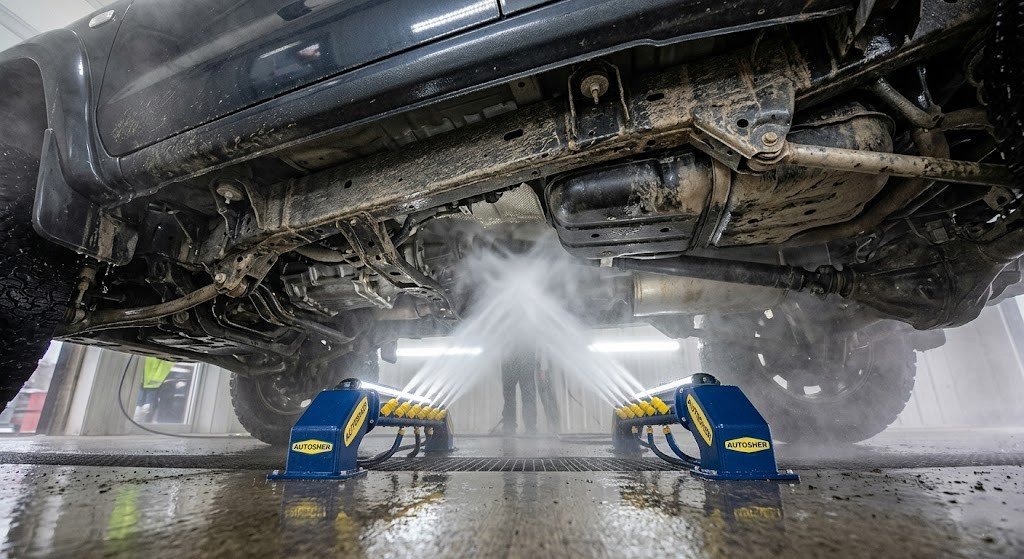
An effective undercarriage wash is not simply a pipe with holes in it. Modern systems are engineered for high-pressure application, comprehensive coverage, and durability in a harsh environment. As an investor, understanding the components is key to choosing a reliable and effective system.
Key Components and Design
- High-Pressure Nozzles: The core of the system is a series of zero-degree or oscillating nozzles. These are designed to create powerful, concentrated jets of water that can dislodge caked-on mud and flush away corrosive salts. The number and arrangement of these nozzles determine the thoroughness of the cleaning.
- Stainless Steel Construction: The entire manifold and its components are constantly exposed to water, chemicals, and road grime. Stainless steel construction is essential for longevity and to prevent the system itself from corroding.
- Integration with Conveyor and PLC: The undercarriage wash must be precisely controlled by the tunnel’s PLC (Programmable Logic Controller). It should activate only when a vehicle is directly overhead to conserve water and energy. The system can often be programmed to run at different pressures or durations depending on the wash package selected by the customer.
- Optional Chemical Application: Some advanced systems can apply a specialized undercarriage treatment or rust inhibitor after the initial water blast. This provides an additional layer of protection and creates another potential upsell opportunity.
Placement and Integration within the Tunnel
The undercarriage wash is typically one of the first components in the wash tunnel. It is placed at the entrance, often as part of the initial pre-soak arch. This allows the high-pressure blast to remove heavy, abrasive materials from the chassis before the vehicle proceeds to the friction brushes, ensuring that this grit is not carried into the main wash process. AUTOSHER systems are designed for seamless integration, ensuring the undercarriage wash works in perfect sync with the rest of the tunnel equipment.
Section 3: The Business Case – ROI and Revenue Enhancement
Installing an undercarriage wash system is a capital investment, and like any investment, it must generate a clear return. The financial benefits are realized through several channels.
Creating a High-Value Mid-Tier Package
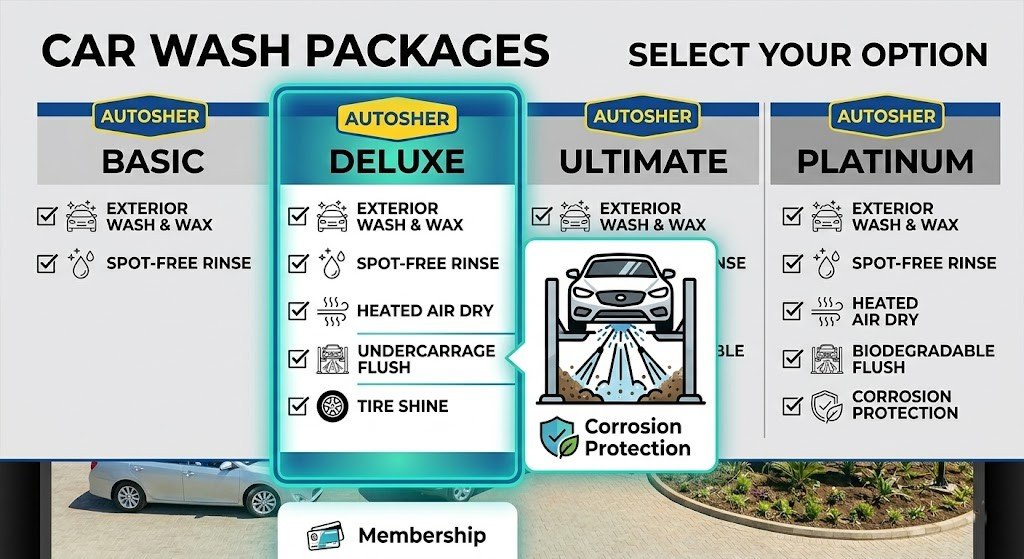
The undercarriage wash is the perfect feature to differentiate your “basic” wash from your more profitable “better” and “best” packages. A typical pricing structure might look like this:
- Basic Wash ($12): Wash & Dry
- Deluxe Wash ($17): Wash & Dry + Undercarriage Flush + Triple Foam Polish
- Ultimate Wash ($25): All of the above + Ceramic Sealant + Tire Shine
The undercarriage wash provides a tangible, functional benefit that makes the $5 jump from Basic to Deluxe easy for the customer to justify. Since the marginal cost of activating the undercarriage system (a few gallons of water and cents of electricity) is very low, nearly the entire upsell amount flows directly to your bottom line.
Driving Membership Sales
By including the undercarriage wash in your top-tier unlimited wash club membership, you add another layer of value. You can market the membership as “The best way to protect your vehicle year-round,” a message that is particularly powerful in the winter months. Customers who understand the threat of road salt are more likely to see a monthly membership that includes regular undercarriage flushes as a smart investment in their vehicle’s longevity.
Section 4: Marketing and Customer Education
Simply having the equipment is not enough; you must effectively communicate its value to your customers. Many drivers are unaware of the dangers lurking beneath their cars, and education is key to driving sales.
On-Site Signage and Visual Cues
Your marketing starts at your facility. Use clear, concise signage at the payment kiosks and tunnel entrance.
- “Protect Your Vehicle From Damaging Road Salt!”
- “Add an Undercarriage Flush to Fight Rust!”
- “The Wash You Can Feel, The Protection You Need.”
Consider installing LED lights around your undercarriage system. When it activates, the visual spectacle of the lights and the high-pressure spray provides a show” for the customer