
Blog
What’s the difference between soft-touch and touchless automatic car washes?

As a car wash investor or operator, the choice between a “soft-touch” (friction) system and a “touchless” system is one of the most fundamental decisions you will make. This choice defines your business model, dictates your operational costs, shapes your marketing message, and ultimately determines the quality of the product you deliver. The consumer’s question about the difference between these two technologies is an opportunity for you to understand the profound strategic implications of each path.
This comprehensive B2B analysis will provide a definitive breakdown of the soft-touch versus touchless debate from an operator’s perspective. We will move beyond the surface-level marketing claims to dissect the underlying science, operational mechanics, financial realities, and customer satisfaction outcomes of each system. The goal is to provide a clear, evidence-based framework that will empower you to make the most informed and profitable investment decision for your car wash enterprise. At AUTOSHER, we specialize in advanced soft-touch systems because we believe they offer a scientifically superior clean and a more financially sustainable business model.
Section 1: Defining the Core Technologies
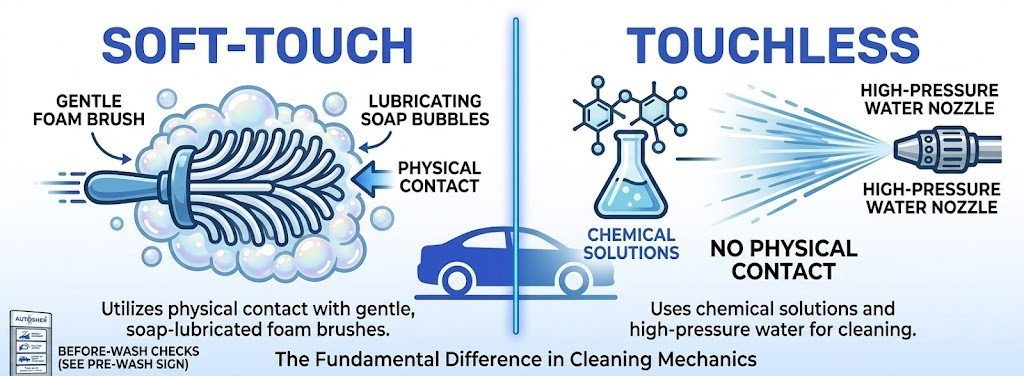
At the most basic level, the difference lies in how the systems remove dirt from a vehicle’s surface. Both systems must overcome the static bond that holds road film and grime to the paint, but they use fundamentally different forces to do so.
Soft-Touch (Friction) Car Wash
A modern soft-touch car wash uses physical contact to clean the vehicle. However, it is critical to distinguish this from the outdated, abrasive nylon bristle brushes of the past.
- The “Touch” Element: The system uses advanced, gentle wash media—either high-quality soft cloth or, more commonly, closed-cell foam—to lightly agitate the vehicle’s surface.
- The “Soft” Element: This agitation happens under a constant, high-volume flow of lubricating, pH-balanced soaps. This creates a slippery barrier, allowing the foam to glide over the surface and lift away encapsulated dirt particles safely.
- Primary Cleaning Forces: Gentle physical agitation + Chemical lubrication.
Touchless Car Wash
A touchless car wash, as its name implies, cleans without any physical contact between the wash media and the vehicle.
- The “Touchless” Element: No brushes or foam ever touch the car’s paint. The cleaning is performed by robotic gantries or arches.
- The Compensating Forces: To make up for the lack of physical agitation, touchless systems must rely on a more aggressive combination of chemicals and high-pressure water. This typically involves a two-step chemical process (acidic and alkaline) to break down dirt, followed by an intense, high-pressure rinse to blast it off.
- Primary Cleaning Forces: Aggressive chemical reaction + High-pressure kinetic energy.
Section 2: The Quality of Clean – A Head-to-Head Comparison
For a customer, the ultimate measure of a car wash is the result. In this critical area, there is a clear and demonstrable difference between the two technologies.
The Challenge of Road Film
The most difficult contaminant to remove is “road film”—a thin, oily, and statically bonded layer of grime that makes paint look dull and hazy.
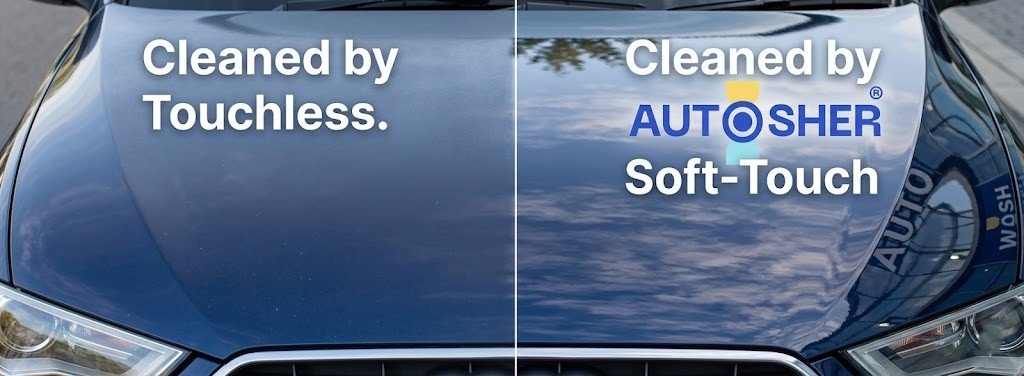
- Touchless Performance: This is the Achilles’ heel of the touchless model. Without physical agitation, even the strongest chemicals and highest pressure often fail to remove this final layer of film. A car may look clean while wet, but once dry, a customer can often wipe a finger across a panel and see the grime left behind.
- Soft-Touch Performance: The gentle wiping action of the closed-cell foam is exceptionally effective at safely removing this bonded road film. The result is a surface that is not only visually clean but physically smooth and squeaky to the touch.
Stubborn Contaminants
For heavier contaminants like bug splatter, bird droppings, or tree sap, the difference is even more pronounced. The soft-touch system’s gentle scrubbing action is far more effective at breaking down and removing these tough spots than chemicals and pressure alone.
Section 3: The Operator’s Balance Sheet – A Financial Deep Dive
For an investor, the decision must be driven by long-term profitability. This requires a careful analysis of both revenue potential and operating costs.
Cost Per Car (CPC)
The touchless model consistently has a higher variable Cost Per Car.
- Chemical Costs: Touchless systems use more chemical per car, and the aggressive, two-step acid/alkaline chemicals are typically more expensive than the pH-balanced lubricating soaps used in soft-touch systems.
- Energy Costs: The massive, high-horsepower motors required to run the high-pressure pumps in a touchless system consume significantly more electricity than the smaller, more efficient motors used to spin lightweight foam brushes.
- Water Costs: High-pressure systems often use more water per vehicle, leading to higher utility bills.
Revenue Potential
The superior cleaning quality of a soft-touch system allows it to support a more premium brand position.
- Higher Customer Satisfaction: A cleaner, shinier car leads to happier customers, better online reviews, and stronger repeat business.
- Justification for Premium Pricing: Because the result is visibly better, operators can more easily charge for and sell high-margin services like ceramic coatings, which require a perfectly clean surface to bond to.
While a touchless system may sometimes have a slightly lower initial capital cost, the higher ongoing operational costs and lower revenue ceiling of the soft-touch model make it the more financially attractive investment over the life of the equipment.
Section 4: The Paint Safety Debate – Perception vs. Reality
This is the most contentious point and where marketing often diverges from science.
The Touchless Marketing Advantage
The primary advantage of the touchless model is its marketing message: “Nothing touches your car.” This is a simple and powerful way to alleviate the fears of customers who are worried about scratches from old-fashioned brushes.
The Soft-Touch Scientific Reality
The fear of “brushes” is based on outdated technology. Modern closed-cell foam is scientifically incapable of scratching a vehicle’s clear coat. It is non-porous and operates under constant lubrication. In contrast, the touchless model introduces its own safety risks:
- Chemical Wear: The long-term effects of repeated acid/alkaline chemical cycles can be harsh on a vehicle’s plastic trim, rubber seals, and any existing waxes or sealants.
- High-Pressure Damage: Intense water jets can potentially lift loose emblems, damage pinstriping, or force water past worn seals.
A modern soft-touch system is not only safe but arguably safer for the overall health of a vehicle’s various surfaces than the aggressive chemical and pressure-based approach.
Section 5: Conclusion for the Investor – A Strategic Choice
The choice between soft-touch and touchless is a choice between two different business philosophies.
- The Touchless Model is a bet on marketing. It prioritizes a simple, fear-based marketing message over ultimate cleaning quality and accepts the trade-off of higher operating costs and a potentially less satisfied customer base. It is often chosen for in-bay automatic (IBA) locations where throughput is lower and the “do no harm” message is paramount.
- The Soft-Touch Model is a bet on product quality. It is built on the premise that delivering a demonstrably cleaner, shinier car is the best form of marketing. It leverages advanced materials and engineering to provide a superior result at a lower operating cost, making it the dominant choice for high-volume express exterior tunnels where efficiency and customer satisfaction are the keys to profitability.
For the serious investor looking to build a scalable, high-volume, and profitable car wash business, the modern soft-touch system represents the more robust and financially sound technological foundation.