Blog
Are automatic car washes safe for car paint?

For a car wash investor or operator, the answer to this question must be an unequivocal, demonstrable “yes.” Your entire business model rests on the trust that customers place in you to protect their second most valuable asset. A single incident of paint damage, real or perceived, can inflict irreparable harm on your brand’s reputation and financial health.
This B2B analysis will move beyond a simple consumer-facing answer to provide a comprehensive operational and technological breakdown. We will dismantle the outdated myths that fuel customer anxiety and explore the specific systems, materials, and processes that define a genuinely paint-safe car wash. Understanding these elements is not just about mitigating risk; it’s about building a superior service that can command premium pricing and foster long-term customer loyalty. At AUTOSHER, engineering for paint safety isn’t a feature—it is the core design principle of every component we manufacture.
Section 1: Overcoming History – The Evolution from Abrasive Bristles to Gentle Foam
The fear of automatic car washes is not entirely unfounded; it’s rooted in the technology of the past. Early automatic systems in the mid-20th century used stiff, abrasive nylon bristle brushes. These brushes, combined with less-advanced chemical formulations, were indeed capable of hazing a vehicle’s finish and creating the fine, circular scratches known as “swirl marks.” This history created a powerful and persistent myth that all “brushes” are bad for paint.
The modern car wash has undergone a materials science revolution to solve this problem. The industry has completely moved away from abrasive bristles. Today’s premium systems use one of two advanced materials:
- Soft Cloth (Felt): Long strips of soft, felt-like cloth are gentle on a vehicle’s surface. When properly saturated with water and lubricating soaps, they provide a mild polishing effect. However, cloth is porous and can become heavy when water-logged, requiring more powerful motors and potentially holding onto dirt if not impeccably maintained and flushed.
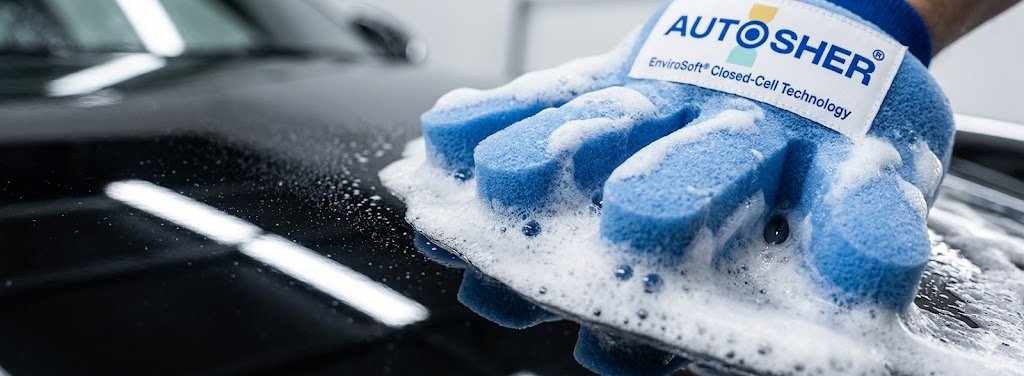
- Closed-Cell Foam: This is the undisputed gold standard for paint-safe, high-volume car washing. AUTOSHER’s EnviroSoft® brushes, for example, are made from an engineered, non-porous foam. Unlike a sponge or cloth, it cannot absorb water or trap abrasive grit particles. It cleans by gently gliding over the vehicle’s surface under a constant stream of lubrication. Any dirt is immediately whisked away from both the car and the brush itself. This material is scientifically incapable of scratching a modern clear coat.
For an operator, choosing a system with closed-cell foam is the first and most important step in building a verifiably paint-safe operation. It is a feature that should be at the forefront of your marketing efforts to directly counter outdated consumer fears.
Section 2: The Chemistry of Protection – pH Balance and Lubrication
Physical contact is only one part of the equation. The chemical solutions used in your wash have a direct and immediate impact on a vehicle’s paint, clear coat, and trim. An improper chemical program can be just as damaging as an abrasive brush.
The Critical Role of pH
A vehicle’s clear coat is most stable at a neutral pH of 7. Using highly acidic (low pH) or highly alkaline (high pH) chemicals is a risky proposition. While they can be effective at breaking down specific contaminants (like brake dust or heavy road film), they can also strip protective waxes and sealants, and in extreme cases, even etch the clear coat if not applied and neutralized correctly. A paint-safe operation uses precisely formulated, pH-balanced or mildly alkaline detergents for the primary friction stage. These soaps are designed to lift dirt, not blast it off with harsh chemical force.
The Unsung Hero: Lubricity
The most important property of a car wash soap is its lubricity. The soap’s primary job is to create a slippery, protective barrier between the wash media and the vehicle’s surface. This cushion of suds allows the closed-cell foam to glide effortlessly, encapsulating dirt particles and lifting them away safely. A low-quality, non-lubricating soap forces the wash media to do all the work, increasing the risk of micro-abrasions. Investing in premium, high-lubricity chemicals is a direct investment in paint safety and customer satisfaction.
Section 3: The Unseen Threats – Water Quality and Intelligent Control
Beyond brushes and soap, two other critical factors contribute to a paint-safe process: the water you use and the intelligence of the system that controls the equipment.
Hard Water and Spotting
The water itself can be a threat. Hard water is full of dissolved minerals like calcium and magnesium. When this water evaporates on a car’s surface, it leaves these minerals behind as stubborn white spots. In severe cases, these spots can etch into the clear coat, requiring machine polishing to remove. A truly professional, paint-safe car wash must offer a spot-free rinse as its final step. This is achieved by a Reverse Osmosis (RO) system that purifies the water, removing all dissolved solids. An RO rinse ensures a perfect, blemish-free finish.
The Brains of the Operation: PLC and Sensor Technology
A modern car wash is a robot. It uses an array of sensors (photoelectric eyes, ultrasonic scanners) to create a unique 3D profile of every vehicle that enters. This data is fed to the Programmable Logic Controller (PLC), the system’s brain. The PLC then makes real-time adjustments:
- It tells the top brush to lower for a sedan and stay high for a pickup truck.
- It instructs the side brushes to retract slightly to safely navigate around side mirrors.
- It ensures the equipment maintains a precise, consistent pressure, never pushing too hard against the vehicle.
This intelligent control system is a crucial safety feature that prevents the physical damage (broken mirrors, antennas) that can occur in less sophisticated systems. It ensures that the gentle wash media is applied with an equally gentle and intelligent touch.
Section 4: The Touchless Alternative – A Different Kind of Risk
Many consumers believe touchless car washes are inherently safer because nothing physically touches the car. However, from an operator’s perspective, this model simply trades one set of risks for another. To compensate for the lack of physical agitation, touchless systems must rely on a more aggressive combination of harsh chemicals (highly acidic and alkaline) and extremely high-pressure water jets. This can lead to its own set of problems, including the potential for chemical stripping of waxes, fading of plastic trim, and damage to emblems or seals from the high-pressure blast.
Section 5: The Operator’s Responsibility – The Final Layer of Safety
Even the most advanced, paint-safe equipment in the world can be rendered unsafe by poor maintenance and operational neglect. As the owner, you are the final guarantor of safety.
A Rigorous Maintenance Schedule
A non-negotiable, preventative maintenance schedule is critical. This includes:
- Daily Tunnel Walks: Visually inspecting all wash media for embedded foreign objects (a rare but possible occurrence) and checking that all nozzles are spraying correctly.
- Weekly Chemical Checks: Verifying that your chemical dilution systems are functioning correctly. A malfunctioning unit could deliver a solution that is too aggressive.
- Regular Equipment Service: Following the manufacturer’s recommended service intervals for all mechanical components to ensure they are operating within safe parameters.
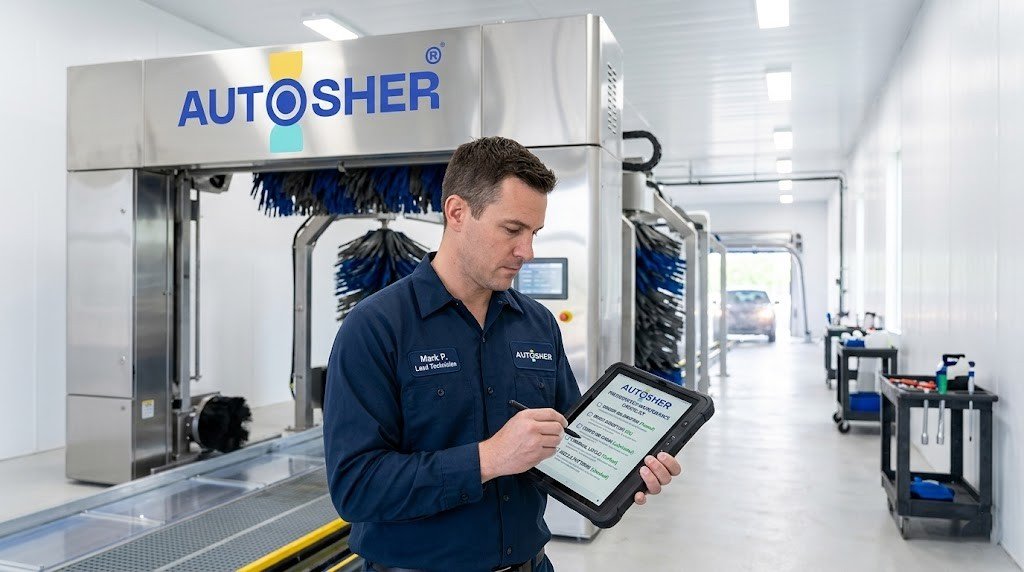
AUTOSHER systems are designed with remote diagnostics, allowing our technicians to monitor system performance and alert you to potential issues before they become safety concerns, maximizing both uptime and peace of mind.
Conclusion: A System of Safety
So, are automatic car washes safe for car paint? The definitive answer is that a modern, well-maintained car wash equipped with closed-cell foam media, pH-balanced lubricating soaps, intelligent sensor controls, and a spot-free rinse is not only safe—it is scientifically safer than a typical hand wash. Safety is not a single feature but an integrated system. By investing in this system and committing to professional operational standards, you can confidently answer your customers’ most pressing question and build a trusted, profitable business on a foundation of asset protection.