Blog
How much does a basic automatic car wash typically cost?

The consumer’s question, “How much does a basic automatic car wash typically cost?” is a search for a simple number. For a car wash investor or operator, that number is the end result of a complex strategic process. The price of your entry-level or “basic” wash is the most important number on your menu. It’s the anchor that defines the value of every other package you offer, the gateway for new customers, and a critical lever in your strategy to build a profitable, subscription-based business.
This B2B guide will deconstruct the process of setting the price for your basic car wash. We will move beyond simply looking at the “average” price in your area and dive into the essential calculations and strategic considerations that lead to an optimal price point. From calculating your hard costs to positioning your brand and driving upsells, we will provide a framework for using your basic wash price as a powerful tool to maximize revenue and profitability. The efficiency and reliability of your AUTOSHER equipment play a direct role in this process by helping to lower your costs and justify your value proposition.
Section 1: The Hard Floor – Calculating Your Cost Per Car (CPC)
Before you can determine your price, you must know your cost. The price must be profitable. The foundational metric for this is your variable Cost Per Car (CPC). This is the sum of all direct costs incurred to wash one additional vehicle. If your basic price does not comfortably exceed your CPC, your business is not sustainable.
The Key Components of CPC
- Water & Sewer: Calculate the cost per gallon for both fresh water and sewer discharge. A modern system with a water reclamation unit can drastically reduce this cost, but you must account for the fresh water used (e.g., for the final rinse) and the portion of water sent to the sewer. An efficient AUTOSHER system might use only 15-20 gallons of fresh water per car.
- Electricity: This is a major cost, driven by motors for the conveyor, brushes, and dryers. Calculate your facility’s total kilowatt-hour (kWh) cost and estimate the energy consumed per wash cycle. Investing in equipment with energy-efficient motors and VFDs directly lowers this component of your CPC.
- Chemicals: This is your most direct variable cost. Work with your chemical supplier to determine the precise cost-per-application for your basic wash package, which typically includes a pre-soak and a friction soap. Accurate chemical dilution systems are critical to controlling this cost.
- A Pro-Rated Maintenance Allowance: A small, predictable amount (e.g., $0.15-$0.25) should be allocated from every wash to a fund for replacing wear items like brush media.
By adding these costs, you arrive at your hard floor. For a modern, efficient wash, this might be in the range of $1.75 to $2.50. This is the number below which you cannot go.
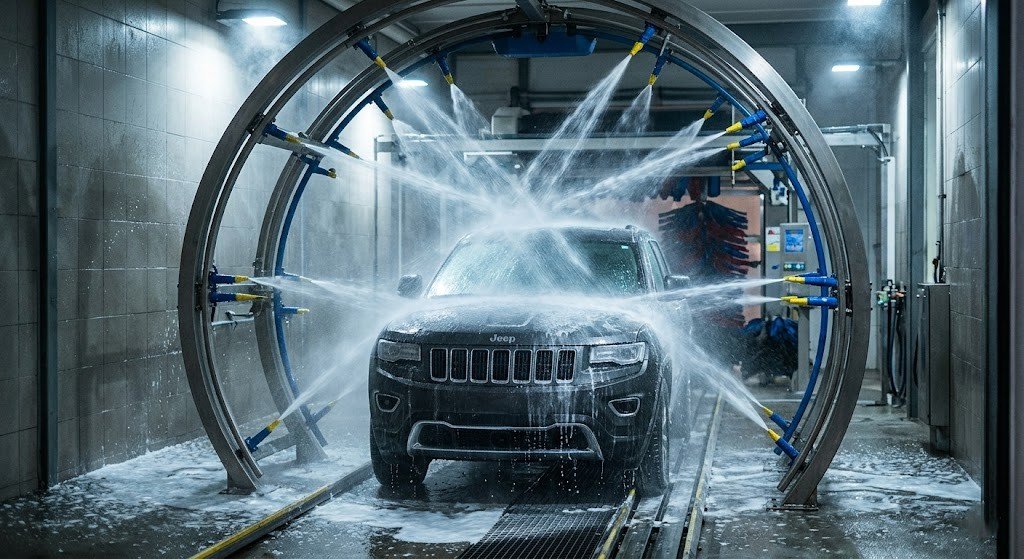
Section 2: The Market Ceiling – Competitive Analysis
Once you know your cost floor, you need to understand your market. Your pricing exists relative to your competitors. This requires on-the-ground intelligence gathering.
Become a Secret Shopper
Visit every competitor within a 3-5 mile radius. Do not just look up their prices online. Experience their service firsthand and document everything:
- Price: What is the exact price of their lowest-tier wash?
- Inclusions: What services are included in that price? Is it just a wash and dry? Do they include an undercarriage flush?
- Quality: How good was the result? Was the car actually clean? Was it dry? Were the wheels still dirty?
- Experience: Was the facility clean? Was the staff friendly? Was the process fast and easy?
Positioning Your Basic Wash
This analysis allows you to position your basic offering strategically. If the local average is $10 for a poor-quality wash from a dirty facility, pricing your superior basic wash at $12 or $13 is not being “expensive”; it is establishing a premium position. Conversely, if a competitor offers a decent $12 wash, you may need to price yours at $12 as well, but you can then compete by offering a visibly better result or a better overall experience (like free vacuums), thereby creating a superior value proposition at the same price point.
Section 3: The Psychology of the Menu – The Basic Wash as an Anchor
The primary strategic role of the basic wash is often not to be your biggest seller, but to make your other packages look more appealing. This is a classic pricing strategy known as “anchoring.”
Designing Your “Good, Better, Best” Ladder
A well-designed menu guides customers toward the choice you want them to make (typically the mid-tier “Better” package).
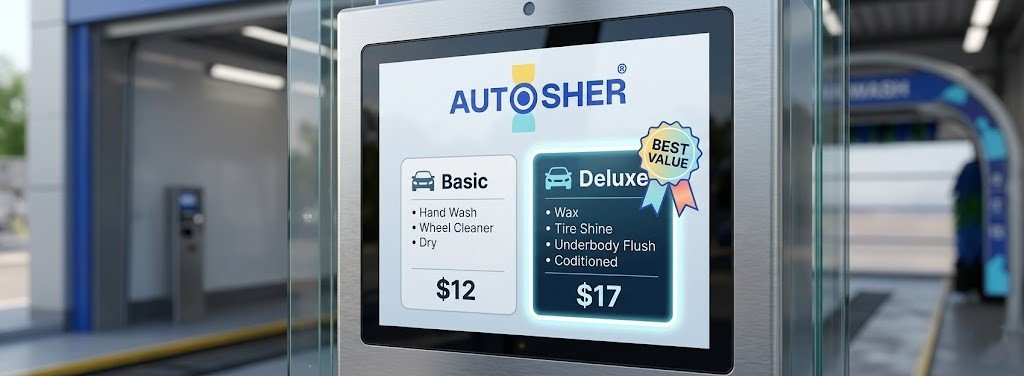
- Basic (Good): Your entry-level price. Let’s say you set it at $12. It delivers a great core product but lacks the exciting add-ons.
- Deluxe (Better): This package should offer a significant jump in perceived value for a modest price increase. For $17 (a $5 jump), you add high-value, low-cost services like an Undercarriage Flush, Triple Foam Polish, and Wheel Cleaner.
- Ultimate (Best): This is your high-margin, premium offering. For $24 (a $7 jump), you add your most advanced products like Ceramic Sealant and Tire Shine.
In this structure, the $12 price makes the $17 package look like a fantastic deal. The customer sees that for just $5 more, they get three additional valuable services. The basic price serves as the essential first rung on your value ladder.
Section 4: The Gateway to Recurring Revenue – The Subscription Connection
The final and most important role of your basic wash price is to make your unlimited wash club membership an irresistible offer.
The “Twice the Price” Rule of Thumb
A powerful pricing tactic is to price your top-tier monthly membership at roughly double the price of a single top-tier wash. However, the basic wash price also plays a role. Customers often compare the price of the *basic membership* to the price of a *single premium wash*.
Let’s use our menu from above:
- Single Basic Wash: $12
- Single Ultimate Wash: $24
- Unlimited Basic Membership: $25/month
- Unlimited Ultimate Membership: $45/month
A customer who typically buys the basic wash sees that for the price of just two single washes, they can get unlimited access for a month. More powerfully, a customer considering the single Ultimate wash for $24 sees that for just one dollar more, they can get the *basic* membership and wash all month. This often leads them to upgrade to the Ultimate membership for $45, as it represents the best overall value. The price of the basic wash is a critical reference point in all of these mental calculations.
Section 5: The Value Proposition – What a “Basic” Wash Must Include
To command a fair price, even your most basic offering must be perceived as high value. In the modern Express Exterior model, this value extends beyond the tunnel.
The Core Product Must Be Flawless
A “basic” wash cannot be a “bad” wash. It must still deliver a clean, dry, and shiny car. This is where the quality of your equipment is non-negotiable. A customer paying for your entry-level service must be impressed enough to trust you with their future business and consider upgrading or becoming a member.
The Power of Free Vacuums
In the express model, free-to-use vacuums are a standard and expected feature. This is a massive part of the value proposition. A customer paying $12 for a basic wash is also getting access to $5-10 worth of free vacuum time. This amenity dramatically increases the perceived value of even your lowest-priced offering and is a major competitive advantage over older models that charge for vacuums.
A Clean and Safe Environment
The price of the wash also includes the experience of being at your facility. A clean, well-lit, and safe environment is part of the product. This helps justify your price point against a competitor who may be a dollar cheaper but operates a run-down, uninviting facility.
Conclusion: More Than Just a Price Tag
The typical cost of a basic automatic car wash in most US markets today ranges from $10 to $15. However, the actual number is less important than the strategy behind it. For the operator, the price of the basic wash is a multi-faceted tool. It must be set comfortably above your Cost Per Car, positioned intelligently against your local competition, designed to make your premium packages look attractive, and structured to make your membership offerings an obvious choice. By following this strategic framework, the price of your basic wash becomes more than just a number—it becomes the foundation of a profitable and sustainable business.