Blog
What are the benefits of using an automatic car wash versus hand washing?

The debate between automatic car washes and traditional hand washing is a long-standing one among vehicle owners. As an investor or operator in the car wash industry, it is imperative to understand this debate not from the perspective of consumer preference, but from the standpoint of operational efficiency, environmental science, asset protection, and financial viability. The arguments you use to market your facility must be grounded in demonstrable facts that dismantle the persistent myths surrounding hand washing.
This comprehensive analysis will provide a B2B framework for understanding and articulating the distinct advantages of a modern, professional automatic car wash. We will move beyond surface-level convenience and examine the scientific realities of paint care, the significant environmental and regulatory benefits of professional water management, and the scalable business model that automation enables. The goal is to equip you with the substantive knowledge needed to confidently assert the superiority of your service and justify its value to your customers. AUTOSHER’s integrated systems are designed to embody these benefits, delivering a product that is demonstrably safer, greener, and more consistent than any manual alternative.
Section 1: The Science of Surface Protection – Debunking the Hand Wash Myth
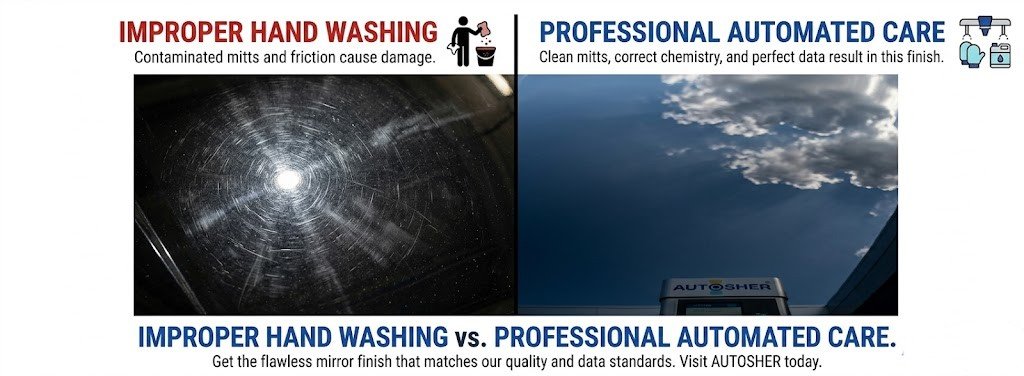
The most common argument for hand washing is that it is gentler on a vehicle’s paint. This is one of the most pervasive and damaging myths in the automotive care industry. From a material science perspective, a typical amateur hand wash is a high-risk activity for a vehicle’s clear coat.
The Abrasive Reality of the Single Sponge
The process is simple and destructive. A bucket of soapy water and a sponge or mitt are used to scrub the entire car. As the sponge moves across the first dirty panel, it picks up sharp particles of dirt, sand, and road grit. This same grit-infused sponge is then dipped back in the bucket, contaminating the water, and subsequently dragged across every other panel of the car. The result is the systematic grinding of abrasive particles into the clear coat, causing thousands of microscopic scratches. Over time, these scratches refract light in all directions, leading to the dull, hazy appearance and visible “swirl marks” common on dark-colored cars.
The Professional Automated Approach
A modern automatic car wash is engineered to eliminate this problem. The process is fundamentally different:
- High-Pressure Rinse: The first step is often a high-pressure rinse that removes the majority of loose, heavy grit before any physical contact is made.
- Constant Lubrication and Rinsing: During the friction stage, pH-balanced, high-lubricity soaps are continuously sprayed onto the vehicle. Simultaneously, the wash media is also constantly being sprayed and rinsed.
- Non-Porous Wash Media: AUTOSHER’s EnviroSoft® brushes are made from a closed-cell foam material. Unlike a sponge, this material is non-porous. It cannot absorb dirty water or trap grit. It cleans by gently gliding over the lubricated surface, and any dirt is immediately rinsed away from both the vehicle and the brush itself.
The result is a process that is scientifically safer for a vehicle’s finish than a typical garden hose and bucket wash. A professional wash minimizes the risk of the very damage that hand washing almost guarantees.
Section 2: Environmental Stewardship and Regulatory Compliance
From an operator’s perspective, this is perhaps the most significant and defensible advantage. A professional car wash is an environmentally responsible choice, a fact that is becoming increasingly important to both consumers and regulators.
The Uncontrolled Runoff of Driveway Washing
A typical hand wash in a driveway can use between 80 and 140 gallons of fresh water. More importantly, this water, now laden with soap, brake dust, oils, and heavy metals from the road, flows directly into storm drains. Storm drains are not treatment facilities; they discharge directly into local rivers, lakes, and streams. In many municipalities, this is illegal and violates local clean water ordinances, potentially exposing homeowners to fines.
The Closed-Loop Professional System
A modern car wash is a model of water efficiency and responsible disposal.
- Water Reclamation: AUTOSHER’s AquaRenew water reclamation systems can capture, filter, and reuse up to 90% of the water from the wash process. This means a single car wash may only consume 10-15 gallons of fresh water, a staggering reduction compared to hand washing.
- Proper Waste Disposal: All water that is not reclaimed is discharged into a sanitary sewer system, where it is sent to a municipal water treatment plant and processed before being returned to the environment.
- Reduced Utility Costs: For the operator, the ROI on a reclamation system is clear and rapid. It drastically cuts water and sewer bills, which are major variable operating expenses, and provides insulation against drought restrictions and price increases.
Marketing your facility as a “green” or “eco-friendly” choice is not just a slogan; it’s a verifiable fact that provides a powerful competitive advantage.

Section 3: The Power of Consistency and Precision
An automatic car wash is a finely tuned piece of industrial machinery designed for one purpose: to produce a consistent result. This level of precision is unattainable in a manual environment.
Chemical Accuracy
Professional car wash chemicals are highly concentrated and designed to be precisely diluted by automated systems. An AUTOSHER system uses hydrominders to ensure that every vehicle receives the exact, manufacturer-specified concentration of pre-soak, detergent, and wax. This guarantees optimal cleaning performance and safety. A hand wash, by contrast, relies on guesswork—pouring an unknown amount of consumer-grade soap into a bucket of water, leading to a solution that is either too weak to be effective or too strong, potentially stripping protective coatings from the vehicle.
Comprehensive Coverage
It is extremely difficult to effectively hand wash certain areas of a vehicle, particularly the undercarriage. Road salt, brine, and mud can accumulate on the chassis, leading to rust and corrosion. A professional car wash offers high-pressure undercarriage flushes that are a critical part of vehicle maintenance, especially in regions with winter weather. This is a service that simply cannot be replicated in a driveway and represents a significant value-add for the customer.
Section 4: The Unbeatable Economics of Speed and Throughput
While consumers value the time savings of an automatic wash, operators understand it as the core of the business model. The efficiency of automation is what makes the express exterior model so profitable.
Time as a Value Proposition
A thorough hand wash can take an hour or more of a person’s time. An express automatic wash delivers a clean, dry car in under five minutes. This immense time savings is a powerful driver of consumer choice in a fast-paced world. It allows a car wash to be an easy errand rather than a weekend project.
Vehicles Per Hour (VPH) and Scalability
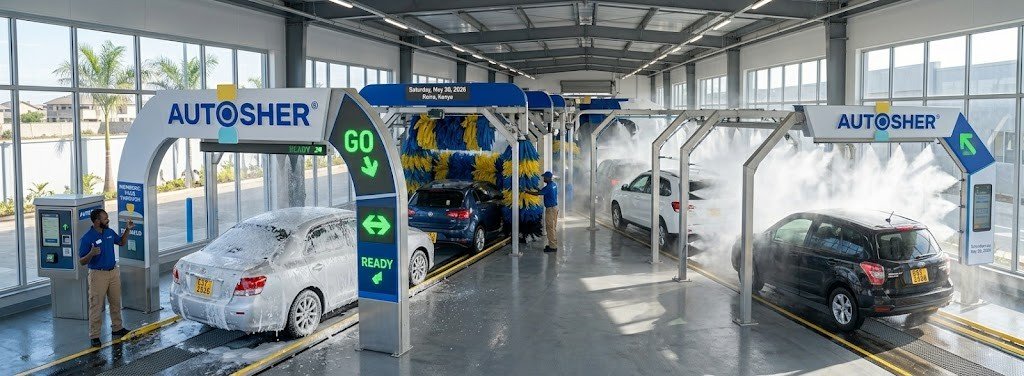
The true business advantage is throughput. A single hand wash bay can service one, maybe two cars per hour. A 120-foot AUTOSHER express tunnel can process over 150 VPH. This massive scalability allows an operator to service thousands of customers in a single weekend, generating revenue at a rate that is mathematically impossible for any business model reliant on manual labor. This high throughput is what makes the unlimited wash club model so financially successful.
Section 5: Predictability, Safety, and Asset Management
Running a business requires managing assets and mitigating risks. From this perspective, an automated system is vastly superior to a labor-intensive one.
Reduced Labor Dependency
A hand wash business is a manual labor business. It is subject to high staff turnover, rising wage pressures, inconsistent quality, and the risks of workplace injuries. An automated car wash requires minimal on-site staff, primarily for customer service and site maintenance. The core work is done by reliable, predictable machinery.
A Depreciable, Consistent Asset
The automated car wash system is a capital asset. Its performance is consistent, its maintenance needs are predictable, and its depreciation can be accounted for. It does not call in sick or deliver a poor-quality job due to fatigue. For an investor, this predictability is crucial for financial modeling and forecasting. The AUTOSHER system, with its remote diagnostics and robust construction, is designed to maximize uptime and provide a reliable, long-term return on investment.
Conclusion: A Clear and Defensible Choice
When viewed through the lens of science, environmental responsibility, and business economics, the automatic car wash is not just an alternative to hand washing; it is a superior solution. It offers a safer and more protective cleaning method for the vehicle, operates with a fraction of the environmental impact, and provides a level of consistency and efficiency that is the foundation of a scalable, highly profitable business model. As an operator, your investment in a high-quality automated system is an investment in a set of clear, demonstrable benefits that form the core of a powerful value proposition for your customers.